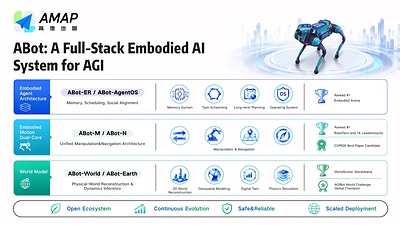
BEIJING, July 23, 2026 /PRNewswire/ — Amap, Alibaba’s location-based services platform, has released a full-stack upgrade to its ABot embodied AI system, introducing ABot-N1, ABot-M0.5, ABot-ER, ABot-AgentOS and ABot-C0 to address key bottlenecks in embodied intelligence — AI systems that enable robots to perceive, reason and act in physical environments.

The upgraded system is designed to improve navigation, manipulation, task reasoning, long-term memory and motion control, and Amap claimed the system achieved state-of-the-art (SOTA) results on 17 widely used benchmarks.
With the upgrade, the ABot architecture is structured as a pioneering full-stack embodied-intelligence technology system. It connects world models, foundation models and an embodied-agent framework, allowing data from simulation training, physical interaction and memory scheduling to feed back into the system and improve performance over time.
ABot-N1, a general navigation foundation model, is aimed at helping robots move through open environments. Conventional navigation maps are built for human users, who can rely on common sense to interpret routes and avoid obstacles. Robots require finer-grained spatial perception to apply such maps safely in the physical world.
To address that issue, ABot-N1 uses a dual-system architecture in which a slower module handles long-range reasoning and a faster module manages real-time control. When navigation errors occur, the model can fall back on visual judgment based on the slower module’s reasoning. It also introduces a pixel-level chain-of-thought process, combining visual inputs with language-based logic to make decisions more traceable.
ABot-N1 can complete city-scale autonomous navigation using navigation maps alone. In evaluations, the model led comparable systems in point-goal navigation, object-goal navigation, instruction following, point-of-interest navigation and person following, with an outdoor navigation success rate of 92.9%, according to Amap.
ABot-M0.5 is a general manipulation foundation model that coordinates robot movement and object interaction. Long-horizon tasks in real environments often require a robot to move and manipulate objects across multiple steps, such as navigating to a water dispenser and filling a cup.
Rather than linking movement and manipulation in a linear sequence, ABot-M0.5 separates locomotion and manipulation into two action streams and uses frame-level implicit actions to align vision, hands and movement at a finer time scale. The model also uses a training method known as "dream self-healing," allowing it to continue generating actions from noisy visual predictions to reduce failures caused by small deviations. In RoboCasa-365 tests, ABot-M0.5 outperformed the previous state of the art by 20.4% on complex tasks and 10.6% on basic tasks.
ABot-ER and ABot-AgentOS form the system’s embodied-agent layer. ABot-ER supports decision-making from perception to action, helping robots reason about relationships among objects, spaces and tasks rather than relying only on visual recognition. ABot-ER achieved SOTA results on three benchmarks and ranked first on Embodied Arena 2D-EQA, a benchmark released by multiple research institutions, as of the announcement.
ABot-AgentOS is designed to turn planning into executable actions. It decouples planning, tool use, execution and verification from the robot body, and connects to different robot forms through plug-in skills. The system supports humanoid, quadruped and wheeled robots, while also providing multimodal lifelong memory across tasks and time. The memory system can be optimized based on failed task trajectories, allowing experience from previous tasks to inform future decisions.
Together, ABot-ER and ABot-AgentOS convert task experience into long-term memory and decision references while preserving the security of local, private memory. Those references can then be fed back into the broader ABot system as shared assets for use by other models.
ABot-C0, the motion-control component, is built to translate decisions from the ABot system into physical actions. The model builds a unified behavioral foundation for quadruped robots and supports collaboration among heterogeneous robot types.
The upgraded ABot system is intended to help robots continue learning and adapting in real-world open environments. The company has released research papers for ABot-N1, ABot-M0.5, ABot-AgentOS and ABot-C0 on arXiv.
Research papers:
ABot-N1: https://arxiv.org/abs/2607.10383
ABot-M0.5: https://arxiv.org/pdf/2607.00678
ABot-AgentOS: https://arxiv.org/abs/2607.10350
ABot-C0: https://arxiv.org/abs/2607.07370